

Citing insufficient participation, two colleges drop men's volleyball after just two years
What these actions could suggest about the perils of roster management

NCAA Division II LeMoyne-Owen College recently discontinued its men’s volleyball program. Two days later, Division III University of Lynchburg did the same thing. In both instances, a predominant reason for the decision was insufficient participation.


When LeMoyne-Owen announced it was starting its program in February 2024, the Memphis Commercial-Appeal reported the school was receiving $75,000 over three years from First Point Volleyball, an arm of the USA Volleyball Foundation focused on growing men’s volleyball. The report also indicated the school would fully fund 4.5 scholarships, the maximum amount permissible in Division II.
LeMoyne-Owen and Lynchburg were both part of a wave of athletic departments adding men’s volleyball during this decade. According to the NCAA’s Sport Sponsorship and Participation database, the total number of NCAA men’s volleyball programs in 2025 across all three divisions was 198, representing a 25% increase (n=40) from 2021.
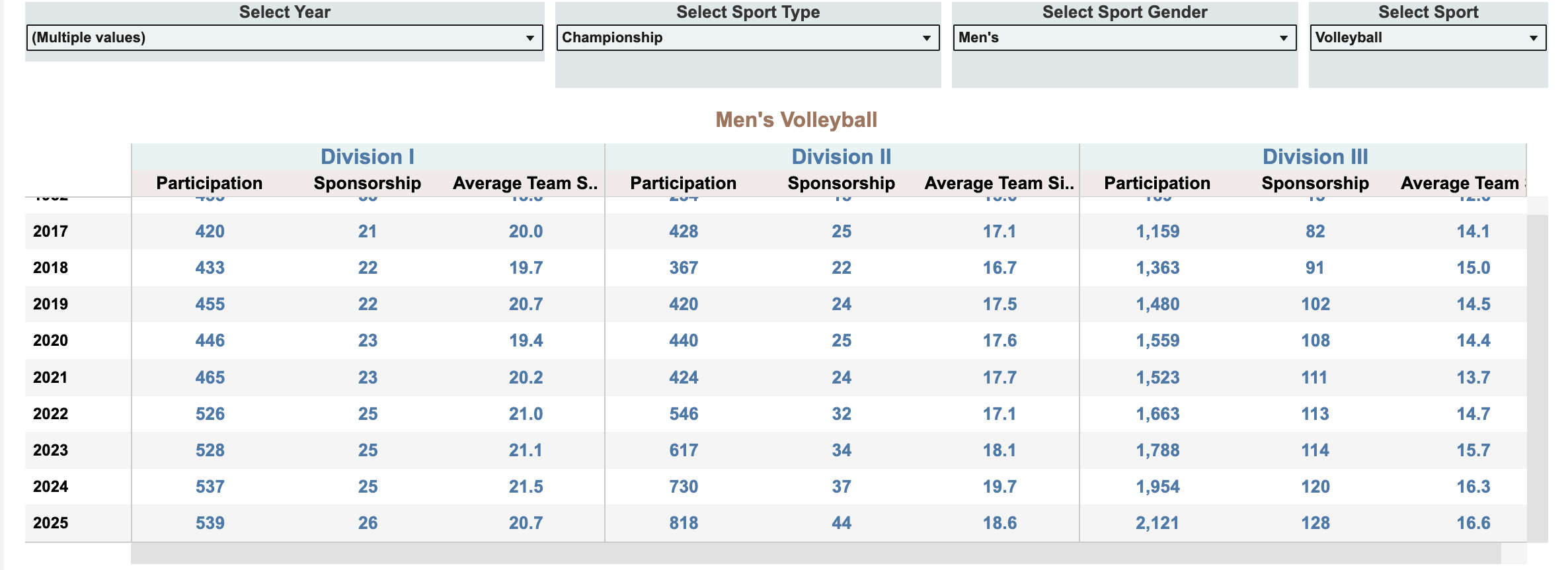
And that trend does not appear to be slowing. According to my data, 13 new men’s volleyball programs were announced since January 1, 2025 (one in D1, two in D2, 10 in D3), making it one of the fastest growing sports at the collegiate level.
This growth reflects the trend line at the high school level, where data from the National Federation of State High Schools Associations (NFHS) shows growth in boys’ volleyball increasing from 63,563 in 2018-19, the year before the pandemic, to 95,972 in 2024-25, a total of 32,409 more athletes.
The overall number of mens’ volleyball athletes participating in the three NCAA divisions in 2024-25 numbered 3,478, approximately 3.6 percent of the high school participation population in the same year. While some of those roughly 90,000 high school players not competing in the NCAA are certainly playing in NAIA, the number of high school athletes suggests citing lack of participation numbers as a reason to discontinue a college program is a stretch.
LeMoyne-Owen, a school of 530 full-time undergraduate students according to its 2024-25 EADA report, went 2-17 in its inaugural season with nine players on its roster. The school canceled its 2026 season and the athletic website listed six players on its 2026 roster as of July 9, 2026, five of whom played in 2025 plus one freshman.
While the lack of participation numbers seems to be a legitimate reason for LeMoyne-Owen, the same can’t really be said for Division III Lynchburg, a school of 1,531 full-time undergraduates per the 2024-25 EADA report. The school’s athletic website listed 14 athletes in 2026 for a team that went 14-12 overall and 10-6 in the Old Dominion Athletic Conference. Not too shabby for a second-year program.
When Lynchburg announced the addition of men’s volleyball in 2023, the news release stressed the strong growth at the high school level as a reason for the sport’s addition. “Boy's volleyball is the fastest growing sport in the U.S. for high school boys with 22% growth in high schools since 2018 according to the Oklahoma Boys Volleyball Association,” read a portion of the release.
Division III schools often sponsor sports as a way to grow enrollment (see, for example, Willner, 2019). The more athletes on a roster, the more tuition, fees, room and board (aka revenue) the school brings in. In this sense, Division III functions in a “pay-for-play” model. Schools in this Division often assign coaches quotas for new recruits. Coaches are integral parts of small college enrollment management.
At the time of the Lynchburg announcement to shutter its program after two years, I speculated on LinkedIn that the language in the release stating the school lacked the “necessary squad size to move our program in a sustainable direction” was really code for “we need a larger roster of tuition-paying volleyball players to fund the sport.” That comment was met with overwhelming agreement.
How many more men’s volleyball players did Lynchburg need to move its program “in a sustainable direction”? That is hard to determine from what limited data private colleges make publicly available. However, Lynchburg’s 2024-25 EADA report indicated the school had 13 men’s volleyball athletes and it reported $103,753 in revenue attributable to the men’s team, an average of $7,981 per athlete. Meanwhile, the school reported 21 women’s volleyball athletes and $207,567 in revenue attributable to the women’s team, an average of $9,884 per athlete.
Lynchburg’s total game-day operating expenses attributed to men’s volleyball were $33,894, $2,607 per athlete. Meanwhile, the total game-day operating expenses attributed to women’s volleyball were $21,296, $1,014 per athlete.
Based solely on those data points, Lynchburg’s men’s volleyball cost nearly $13,000 MORE in game-day operations than its women’s team while generating $100,000 LESS in revenue.
Lynchburg’s athletic website lists 17 players on its 2025 roster while the school’s EADA filing only reported 13. The website identifies 14 players on the 2026 roster.
Only 11 of the 14 players on Lynchburg’s 2026 roster appeared on the 2025 roster, suggesting six players (35%) did not return to the team after the 2025 season. It is important to note that this does NOT mean those six players did not return to the university, only that they were not listed on the roster. Assuming Lynchburg was seeking $200,000 in revenue from its men’s team to match the women’s team, it would need a roster of 25, 11 more than in 2026, at the $7,981 per athlete figure.
Having a roster of 25 men’s volleyball players has the potential to create significant retention issues for the university. The “end-of-bench” players who do not see much, if any, actual game competition, might not be inclined to return the next year, harming the school’s retention and graduation rates. Further, high roster churn - 35% in the case of Lynchburg volleyball - might place additional stress on coaches to recruit more athletes in order to meet quota and revenue targets.
If adding men’s volleyball, or any other sport, for the sake of providing a broad sport sponsorship program that is attractive to a diverse mix students is the college’s goal, great. Colleges should embrace that. When the goal of adding a sport is to create sustained revenue for the institution, problems are likely to emerge.